
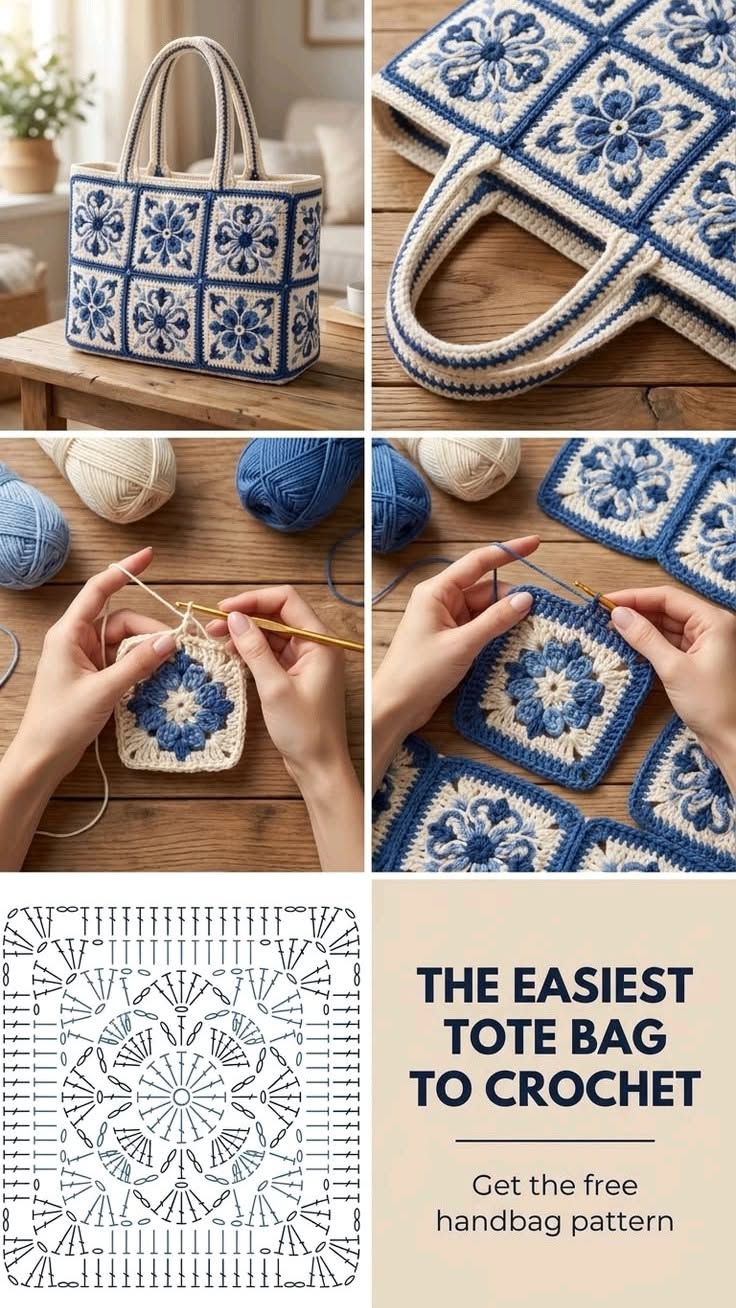
You will crochet nine small floral granny squares, join them into a flat panel, fold it into a bag, and add a firm single crochet base and handles. The squares use only chains, double crochet, and slip stitches, so a confident beginner can finish in about four hours.
Blue & Cream Floral Granny Square Tote Bag
Free crochet pattern · US terms
- Yarn
- 4 – Medium (worsted) — suggested
- Hook
- 4.5 mm (7) — verify with a swatch
- Gauge
- 14 sc x 16 rows = 4 in (10 cm) in single crochet, unblocked. One floral square measures about 4.5 in (11.5 cm) across after Round 5. (calculated, not measured)
- Size
- approx. About 13 in (33 cm) wide, 14 in (36 cm) tall including handles, and 3 in (7.5 cm) deep
- Level
- Confident beginner
- Time
- about 4 h (estimate)
Written and count-checked on paper, not yet physically tested. Make the gauge swatch and the checkpoint below before you commit all your yarn.
The finished bag is a soft-sided tote about 13 in (33 cm) wide and 14 in (36 cm) tall, with a flat crocheted base and two short shoulder handles. Nine identical squares form the front, back, and gusset, so the flower motif repeats on every side.
Each square starts as a small cream flower center worked in the round, then switches to blue for the outer rounds. Squares are joined with slip stitches in a grid, the panel is folded into a bag, and a base is worked directly into the bottom edge. It suits anyone who can hold a steady stitch count and wants a small, portable project.
Before You Start
Materials
Suggested materials. Any yarn of the same weight works if you match the gauge.
1 skein worsted weight acrylic in cream, about 120 yd (110 m)
Acrylic holds its shape and washes well for a bag. Substitute a cotton worsted of the same weight if you prefer a firmer fabric.
2 skeins worsted weight acrylic in medium blue, about 230 yd (210 m) total
Two skeins give you room to match dye lots across all nine squares. A cotton blend works too but may stretch more.
4.5 mm (7) crochet hook
This hook with worsted weight gives a dense fabric that will not gap under load. Go down to 4.0 mm if your squares measure large.
Tapestry needle
Needed for weaving in ends and for reinforcing handle joins. A blunt tip slides between stitches without splitting them.
Stitch marker
Marks the first stitch of each round so the flower center stays even. A short scrap of contrasting yarn works as a substitute.
Yarn needed (estimate): About 350 yd (320 m) total: about 120 yd (110 m) cream and 230 yd (210 m) blue
Gauge and Size
Gauge: 14 sc x 16 rows = 4 in (10 cm) in single crochet, unblocked. One floral square measures about 4.5 in (11.5 cm) across after Round 5.. This gauge is calculated from the yarn and hook above, not measured on a finished sample. Make a 4 in (10 cm) swatch first; change the hook size, not your tension, until it matches.
Finished size (approximate): About 13 in (33 cm) wide, 14 in (36 cm) tall including handles, and 3 in (7.5 cm) deep. Your size depends on your gauge.
Abbreviations (US terms)
| Abbr. | Meaning |
|---|---|
| ch | chain |
| sl st | slip stitch |
| sc | single crochet |
| dc | double crochet |
| st | stitch |
| sts | stitches |
| sp | space |
| rep | repeat |
| FO | fasten off |
Special Stitches
dc cluster (dc-cl)
Work 3 dc into the same stitch but leave the last loop of each on the hook, then yarn over and pull through all 4 loops. This makes one soft petal bump for the flower center.
standing sc
Start with a slip knot on the hook, insert the hook into the first stitch, yarn over, and pull up a loop, then yarn over and pull through both loops. It begins a new color without a visible chain.
How This Pattern Is Written
- All instructions use US crochet terms. The turning chain does not count as a stitch anywhere in this pattern; the first stitch of every row or round is worked into the first stitch.
- Squares are worked in joined rounds: each round ends with a sl st into the first stitch, then the next round begins in that same stitch. Work with the right side facing you throughout.
- Nine squares are joined with sl st through both loops of matching edge stitches; squares are joined flat, right side up, so the join sits on the outside as a design line.
- The bag is made as one flat panel of 3 by 3 squares, then folded so the outer columns become the front and back and the middle column becomes the base and gusset. The base is then reinforced with sc worked into the bottom edge.
- Stitch counts in parentheses at the end of each row or round show the total after that step. Counts are the check that your square will match the others.
- Each square edge is 12 stitches wide (12 dc per side after Round 5), so every seam uses 12 sl sts and every edge sc round uses 36 sc.
The Pattern
Floral Square (make 9)
Join the Squares
Fold and Base
Finishing and Assembly
Sizes and Variations
Smaller market bag
Use 4 squares in a 2 by 2 grid for the front and back only and skip the gusset column. The base round then works about 40 sc and the top edge about 40 sc.
Longer shoulder strap
Work the handle as ch 101 and 100 sc per row instead of 60, and attach the ends about 5 in (12.5 cm) apart for a crossbody length.
Two-color swap
Work the flower center in blue and the outer rounds in cream. Keep the same counts; only the color changes.
Lined bag
Cut a cotton lining to the bag's inside measurements, sew it into a simple open pouch, and hand-sew it just below the top edge for extra structure.
Troubleshooting
| What you see | Likely cause | Fix |
|---|---|---|
| Squares come out different sizes | Tension changed between squares, or one square has the wrong stitch count at a corner. | Recount each square at Round 5; it must read 56 sts. Remake any square that is off by more than 2 sts, and keep the same hook for all nine. |
| The bag sags when loaded | The base is a single layer of sc and the yarn is soft. | Add Base Rounds 2-4 a second time for a double-thick base, or cut a piece of stiff plastic canvas to the base size and slide it inside before seaming the sides. |
| Holes show at the square joins | The sl st join was worked into only one loop, or the join was worked too loosely. | Undo the seam and rejoin through both loops of each matching stitch pair, pulling each sl st snug before moving to the next. |
| The flower center pulls into a cone | Too many stitches were worked into the magic ring, or the ring was not pulled tight. | Check that Round 1 has exactly 12 dc, then pull the ring tail firmly before starting Round 2. Block the square flat with a warm iron held above the fabric, not pressed on it. |
| Handles stretch out of shape | The handle rows were worked too loosely, or the handle ends were attached too far apart. | Work the handles with a hook one size smaller, and pin the ends no more than 3 in (7.5 cm) apart so the weight pulls straight down. |
Care
Machine wash cold on a gentle cycle in a mesh bag, then reshape and dry flat away from direct heat. Do not tumble dry; acrylic can stretch and lose shape. Block squares with a warm iron held just above the fabric before joining.
Questions Makers Ask
How many granny squares do I need for a tote bag?
Nine squares of about 4.5 in (11.5 cm) each make a bag roughly 13 in (33 cm) wide and 14 in (36 cm) tall. Use four squares for a smaller flat bag, or add a row of three for a taller tote and adjust the base round count by about 14 sc per added square.
Can I use cotton instead of acrylic?
Yes. A worsted cotton of the same weight works and gives a firmer bag, but it stretches more under load, so work the handles one hook size smaller. Check your square size against the checkpoint before making all nine.
Do I have to block the squares before joining?
Blocking is not required, but it makes the squares match and the seams line up. If you skip it, pin each square flat and steam it lightly before joining so the corners sit square.
How do I make the bag bigger without changing the squares?
Add more squares in the grid. A 4 by 3 grid gives a wider bag; keep the base round at about 14 sc per square edge and the top edge count the same as the base.
Next: Try a lined zippered pouch using the same floral square as a front panel to practice sewing in a lining and inserting a zipper.