Nestora
No-Sew Crochet Dumpling Plush: Free Crochet Pattern
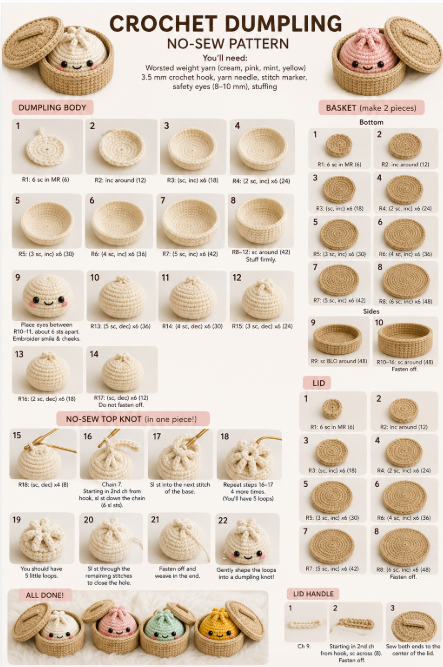
You will crochet a small stuffed dumpling in one continuous piece, so there is no sewing at all. It uses single crochet, increases and decreases, and suits a confident beginner. Plan on about 2 to 3 hours of crochet time as an estimate.
No-Sew Dumpling Plush
Free crochet pattern · US terms
- Yarn
- 4 - Medium (worsted) — suggested
- Hook
- 4.0 mm (G-6) — verify with a swatch
- Gauge
- 16 sc x 18 rounds = 4 in (10 cm) in single crochet worked in continuous rounds, unblocked. Gauge is calculated from the stated hook and yarn and is an estimate, not a measured sample. (calculated, not measured)
- Size
- approx. about 3.5 in (9 cm) wide and 1.75 in (4.5 cm) tall, unblocked
- Level
- Confident beginner
- Time
- about 2 h 30 min (estimate)
Written and count-checked on paper, not yet physically tested. Make the gauge swatch and the checkpoint below before you commit all your yarn.
The finished piece is a rounded, pleated dumpling with a gathered top knot, made from a single ball of yarn. The base is a flat oval worked in continuous rounds, the sides rise straight, then a ring of decreases pulls the top into folds while you stuff it.
Because the stuffing goes in before the last round closes, there is nothing to stitch on afterward. It works as a small desk toy, a stress squish, or a play-food prop.
Before You Start
Materials
Suggested materials. Any yarn of the same weight works if you match the gauge.
1 skein worsted weight acrylic yarn, about 100 g
Acrylic holds pleats well and washes easily. Cotton or a cotton-acrylic blend is a good substitution and gives crisper folds.
4.0 mm (G-6) crochet hook
Slightly smaller than the yarn label suggests, which keeps the stuffing from showing. Go up one size if your stitches are tight.
Polyester fiberfill, a small handful
Firm toy stuffing keeps the dumpling round. Do not use cotton balls or rice, which clump or leak.
Stitch marker
Marks the first stitch of each continuous round. A scrap of contrasting yarn works as a substitute.
Blunt tapestry needle
Used only to weave in the two yarn tails. No sewing of pieces is needed.
Yarn needed (estimate): estimated about 55 to 70 yd (50 to 65 m), well under one 100 g skein
Gauge and Size
Gauge: 16 sc x 18 rounds = 4 in (10 cm) in single crochet worked in continuous rounds, unblocked. Gauge is calculated from the stated hook and yarn and is an estimate, not a measured sample.. This gauge is calculated from the yarn and hook above, not measured on a finished sample. Make a 4 in (10 cm) swatch first; change the hook size, not your tension, until it matches.
Finished size (approximate): about 3.5 in (9 cm) wide and 1.75 in (4.5 cm) tall, unblocked. Your size depends on your gauge.
Abbreviations (US terms)
| Abbr. | Meaning |
|---|---|
| ch | chain |
| sc | single crochet |
| inc | increase: work 2 sc in the same stitch |
| dec | decrease: sc 2 stitches together into one |
| st | stitch |
| sts | stitches |
| MR | magic ring |
| FO | fasten off |
| rep | repeat |
Special Stitches
Magic ring (MR)
Wrap the yarn twice around two fingers, pull the working yarn through the loop, ch 1 to secure, and work the first round into the ring. Pull the short tail to close the hole.
Increase (inc)
Work 2 single crochet stitches into the same stitch. This adds one stitch to the round.
Decrease (dec)
Insert the hook into the front loop of the next stitch, then into the front loop of the following stitch, yarn over and pull through both loops, yarn over and pull through the last 2 loops. This joins 2 stitches into 1.
How This Pattern Is Written
- All instructions use US crochet terms.
- The dumpling is worked in continuous rounds: do not join and do not turn at the end of each round. Move the stitch marker up as you go.
- The first stitch of each round goes into the same stitch as the marker unless the pattern says otherwise.
- The turning chain rule does not apply here because there are no turning chains in continuous rounds.
- Work with the right side facing you at all times; the outside of the fabric is the side you see as you crochet.
- Stuff the piece firmly before the final round so the pleats stay crisp.
- 'Rep from * 6 times' means work the bracketed sequence a total of 6 times around the round.
- Round 17 ends with 3 stitches; the remaining opening is closed with the tapestry needle in the finishing steps, not by further crochet.
The Pattern
Dumpling Body
Finishing and Assembly
Sizes and Variations
Bigger Dumpling
use 5.0 mm (H-8) hook and bulky weight yarn; work the same rounds to Round 6, then add 2 plain rounds before the decreases and stuff more firmly. Finished width grows to about 5 in (13 cm).
Soup Dumpling Look
work Rounds 7-11 in a contrasting color for a two-tone top, changing color at the start of Round 7 and back at Round 12.
Keychain Dumpling
use 3.0 mm hook and sport weight yarn for a piece about 2 in (5 cm) wide, then attach a keyring to the top knot with a short chain loop.
Bun Version
skip the pleat shaping by working Rounds 12-17 as plain sc rounds, then gather the top closed for a smooth round bun.
Troubleshooting
| What you see | Likely cause | Fix |
|---|---|---|
| The base curls into a bowl instead of lying flat at Round 4. | Stitches are too tight, so the circle cannot spread. | Frog back to Round 2 and work the increases more loosely, or switch to a hook one size larger. Check the 24 sc count at Round 4. |
| Stuffing shows through the fabric. | The hook is too large for the yarn or the stitches are loose. | Drop to a 3.5 mm (E-4) hook and work more tightly, or line the inside with a small square of nylon stocking before stuffing. |
| The top knot leaves a hole instead of a closed point. | The final 3 stitches were not pulled tight, or the tail slipped out. | Re-thread the tail, run it through the front loop of all 3 remaining stitches again, and pull firmly before weaving in. |
| The dumpling looks lopsided with pleats on one side only. | The stitch marker drifted, so the decreases stacked in the wrong place. | Count the 36 stitches at the end of Round 6 and re-place the marker in the true first stitch before starting Round 12. |
| The finished dumpling feels hard and lumpy. | Stuffing was added in one large piece. | Tease the fiberfill into small loose tufts and add them in a few stages, starting at Round 14. |
Care
Hand wash in cool water with a little mild soap, squeeze gently without wringing, and reshape while damp. Air dry away from direct heat. Do not tumble dry, because heat can melt acrylic fibers and clump the stuffing.
Questions Makers Ask
Is this really no-sew?
Yes. The whole dumpling is one piece, and the stuffing goes in before the last round closes. The only needle work is weaving in two yarn tails, which is not visible on the outside.
How much yarn does one dumpling use?
About 55 to 70 yd (50 to 65 m) as an estimate, so a single 100 g worsted skein makes several. Actual use depends on your gauge and how firmly you stuff.
Can I make it without a magic ring?
Yes. Chain 2, then work 6 sc into the first chain and join with a slip stitch. The center may show a small hole, so pull the starting tail tight and weave it in.
How do I keep the pleats even?
Count your stitches before Round 12 and keep the marker in the true first stitch of each round. Even spacing of the 6 decrease points is what creates the pleats.
Next: Try a matching crochet steamed bun keychain to practice the same increase-and-decrease shaping on a smaller scale.