Nestora
Pink Blossom Flower Square Free Crochet Pattern
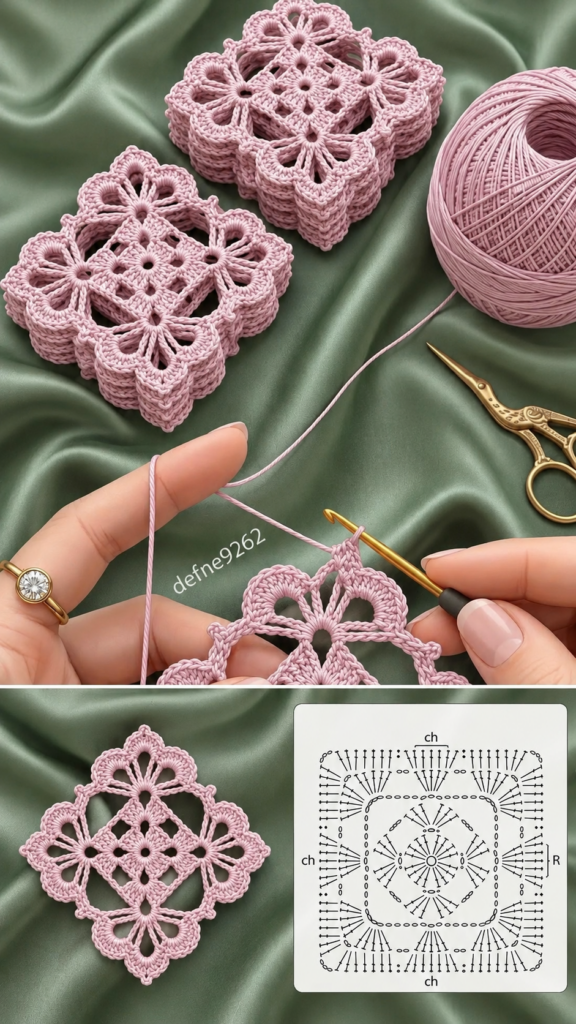
This pattern makes one 6 in (15 cm) square with a five-petal pink flower worked in the round and framed by a sage green border. It uses only chain, slip stitch, single crochet, half double crochet and double crochet, so a confident beginner can finish the first square in about 45 minutes. A set of nine squares for a small blanket is roughly 7 hours of crochet.
Pink Blossom Granny Square
Free crochet pattern · US terms
- Yarn
- 3 - Light (DK) — suggested
- Hook
- 4.0 mm (G-6) — verify with a swatch
- Gauge
- 16 sc x 18 rounds = 4 in (10 cm) in single crochet, worked in the round and unblocked. One finished square measures about 6 in (15 cm). (calculated, not measured)
- Size
- approx. about 6 x 6 in (15 x 15 cm) after light blocking
- Level
- Confident beginner
- Time
- about 45 min (estimate)
Written and count-checked on paper, not yet physically tested. Make the gauge swatch and the checkpoint below before you commit all your yarn.
The square starts as a small pink center, grows into five rounded petals, then switches to green for a squared-off border. Everything is worked in joined rounds with the right side facing you the whole time, so there is no turning and no wrong-side confusion.
It suits anyone who can make a chain and a double crochet. The motif is small enough to practice on and sturdy enough for real use: coasters, a table mat, a cushion front, a tote panel, or joined squares for a blanket.
Before You Start
Materials
Suggested materials. Any yarn of the same weight works if you match the gauge.
1 skein light pink DK yarn, about 50 g / 125 yd
A smooth DK in a light pink keeps the petal stitches readable. Cotton or cotton-blend DK holds the square shape best; substitute any DK acrylic if you plan to machine wash.
1 skein sage green DK yarn, about 50 g / 125 yd
The green border needs slightly more yardage than the flower. A soft sage contrasts without competing with the pink; any muted green DK works.
4.0 mm (G-6) crochet hook
This hook with DK yarn gives a firm, flat square. Go up to 4.5 mm (7) if your stitches are tight and the square cups.
Tapestry needle
Blunt tip, large eye, for weaving in the two yarn tails at the end.
Stitch marker (optional)
Useful for holding the join position in Round 1 if you tend to lose your place.
Yarn needed (estimate): about 30 yd (27 m) total per square: 12 yd (11 m) pink, 18 yd (16 m) green
Gauge and Size
Gauge: 16 sc x 18 rounds = 4 in (10 cm) in single crochet, worked in the round and unblocked. One finished square measures about 6 in (15 cm).. This gauge is calculated from the yarn and hook above, not measured on a finished sample. Make a 4 in (10 cm) swatch first; change the hook size, not your tension, until it matches.
Finished size (approximate): about 6 x 6 in (15 x 15 cm) after light blocking. Your size depends on your gauge.
Abbreviations (US terms)
| Abbr. | Meaning |
|---|---|
| ch | chain |
| sl st | slip stitch |
| sc | single crochet |
| hdc | half double crochet |
| dc | double crochet |
| st | stitch |
| sts | stitches |
| sp | space |
| rep | repeat |
| FO | fasten off |
Special Stitches
Petal cluster (pc)
Work 3 dc into the same chain space, then ch 2, then 3 dc into that same chain space again. The ch-2 sits at the tip of the petal and forms the point.
Corner shell
Work (2 dc, ch 2, 2 dc) into the same chain-2 corner space. The ch-2 is the corner point of the square.
How This Pattern Is Written
- All rounds are worked in joined rounds with the right side facing you. Do not turn between rounds.
- The beginning chain does not count as a stitch in any round, including Round 4. Each round begins with the stated chain and the first real stitch goes into the same stitch as the join, unless the round says otherwise.
- Join each round with a sl st into the first stitch of that round, not into the beginning chain.
- The flower is worked in pink for Rounds 1 to 3. Change to green at the start of Round 4 and carry the pink tail to the wrong side.
- Chain spaces are counted as spaces, not stitches. Stitch counts in brackets count real stitches only.
- Finished squares are joined later with a simple whipstitch or sc join along the edges; joining is not part of this motif pattern.
The Pattern
Pink Flower Center
Petals and Green Border
Finishing and Assembly
Sizes and Variations
Coaster Size
Stop after Round 7 and add one round of sc around for a 4 in (10 cm) coaster; counts stay at 50 sc plus the final sc round.
Two-Color Petals
Work Round 4 in a deeper pink and Round 5 in cream for a layered look, then continue the green border from Round 6.
Larger Blanket Square
Add two plain sc rounds before Round 8, increasing 10 sc per round, to reach about 7 in (18 cm) with the same corner placement.
Solid Square
Replace the ch-2 petal tips in Round 4 with a single dc so the flower reads as a flat medallion under the green border.
Troubleshooting
| What you see | Likely cause | Fix |
|---|---|---|
| The square cups into a bowl shape | Stitches are tighter than the gauge, or the petal clusters are packed too closely. | Switch to a 4.5 mm (7) hook and rework; also check that you skipped one sc between petal clusters as written. |
| The flower has six or four petals instead of five | The Round 3 chain spaces were miscounted, usually from skipping two stitches instead of one. | Recount Round 3 before starting petals: 10 sc and 10 ch-2 spaces. Petals use every other space, giving five. |
| Corners look rounded, not square | The corner chain spaces were worked into a stitch instead of the ch-2 space, or the corner shell was made with too few stitches. | Work the corner shell fully into the ch-2 space and pin the corners firmly when blocking. |
| A gap or hole appears at the join of each round | The beginning chain was counted as a stitch, shifting the join one stitch over. | Treat the beginning chain as a spacer only and always join into the first real stitch of the round. |
| Green border pulls the petals out of shape | The green round was worked too tightly after the color change. | Loosen your tension for Round 5 and work the 3 sc into each petal tip fully so the tip stays rounded. |
Care
Machine wash cold on a gentle cycle in a mesh bag if using cotton or acrylic DK, then reshape and dry flat away from direct heat. Do not tumble dry. Re-block with pins and a light mist whenever the corners soften.
Questions Makers Ask
How much yarn does one flower square use?
About 30 yd (27 m) in total, roughly 12 yd (11 m) pink and 18 yd (16 m) green. That estimate is calculated from the stitch counts and gauge, so buy a little extra for a full blanket.
Can I use worsted weight yarn instead of DK?
Yes, but the square will grow. Use a 5.0 mm (H-8) hook with worsted and expect about 7 in (18 cm) per square, and check the gauge before making a set.
How many squares do I need for a blanket?
It depends on the size you want. At 6 in (15 cm) per square, a small throw of about 36 x 48 in (90 x 120 cm) needs 48 squares, so plan yarn in bulk.
Do I have to block the squares?
Blocking is strongly recommended because it squares the corners and evens the petals. Unblocked squares still work but may join unevenly.
Next: Try a two-color continuous granny square blanket next, which builds on the same joined-round skills without fastening off between squares.