Nestora
Solid Granny Square Crochet Pattern (No Gaps) Free
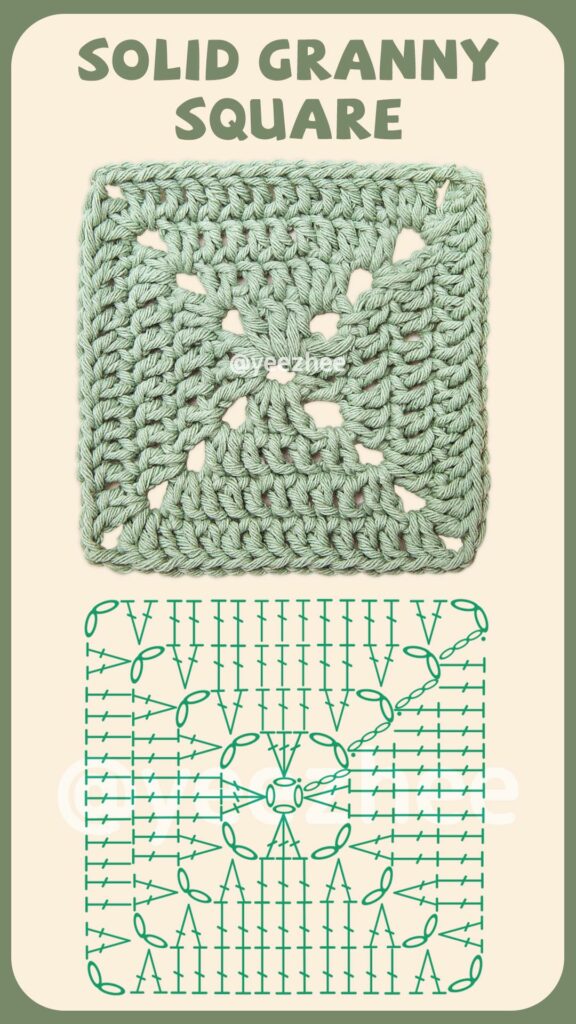
You will crochet a flat, closed granny square worked in continuous rounds from the center out. It needs only chain, double crochet and slip stitch, so a first-time square maker can finish one in about 30 to 45 minutes. A full small blanket of 25 squares is estimated at 8 to 12 hours of crochet plus joining.
Solid Granny Square (No Gaps)
Free crochet pattern · US terms
- Yarn
- 4 - Medium (worsted) — suggested
- Hook
- 5.0 mm (H-8) — verify with a swatch
- Gauge
- 12 dc x 6 rounds = 4 in (10 cm) in double crochet, unblocked, measured on the flat side of the square (calculated, not measured)
- Size
- approx. About 4 in (10 cm) square after Round 6, measured from the stated gauge; size changes with yarn and hook
- Level
- Beginner
- Time
- about 40 min (estimate)
Written and count-checked on paper, not yet physically tested. Make the gauge swatch and the checkpoint below before you commit all your yarn.
A solid granny square is a closed square motif: the center is filled in with double crochet instead of open chain spaces, so the fabric reads as one smooth block of color. Each round adds one double crochet to every side and a chain-2 corner, which keeps the square flat and lets it grow evenly.
It is worked in joined rounds, turning is not needed, and the right side always faces you. The same square works as a coaster, a potholder face, a bag panel or a blanket motif, and the round-by-round counts make it easy to stop at any size.
Before You Start
Materials
Suggested materials. Any yarn of the same weight works if you match the gauge.
1 skein medium (worsted, CYC 4) acrylic yarn, about 100 g / 170 yd
Acrylic holds the square flat and washes well. Cotton medium yarn is a good substitute and gives a crisper corner, especially for potholders.
5.0 mm (H-8) crochet hook
Matches medium yarn for a firm, gap-free fabric. Go down to 4.5 mm (7) if your rounds ruffle.
Tapestry needle, blunt tip
Needed to weave in the two yarn tails. A blunt tip slides between stitches without splitting them.
Stitch marker (1)
Marks the first stitch of the round so you do not lose your place. A short scrap of contrasting yarn works too.
Tape measure or ruler
Used for the checkpoint measurement and the final size check.
Yarn needed (estimate): Estimated about 12 to 16 yd (11 to 15 m) per square; about 350 yd (320 m) for a 25-square blanket
Gauge and Size
Gauge: 12 dc x 6 rounds = 4 in (10 cm) in double crochet, unblocked, measured on the flat side of the square. This gauge is calculated from the yarn and hook above, not measured on a finished sample. Make a 4 in (10 cm) swatch first; change the hook size, not your tension, until it matches.
Finished size (approximate): About 4 in (10 cm) square after Round 6, measured from the stated gauge; size changes with yarn and hook. Your size depends on your gauge.
Abbreviations (US terms)
| Abbr. | Meaning |
|---|---|
| ch | chain |
| dc | double crochet |
| sl st | slip stitch |
| st | stitch |
| sts | stitches |
| sp | space |
| rep | repeat |
| FO | fasten off |
Special Stitches
Chain-2 corner (ch-2 sp)
Work 2 chains between the last double crochet of one side and the first double crochet of the next side. These 2 chains form the corner space that keeps the square flat.
Standing double crochet (optional)
Instead of a beginning chain-3, pull up a loop on the hook, yarn over, and complete a double crochet into the first stitch. It gives a neater round start; the standard chain-3 method is written in the pattern.
How This Pattern Is Written
- All instructions use US crochet terms.
- The square is worked in joined rounds, right side facing throughout; do not turn at the end of a round.
- The beginning chain-3 counts as the first double crochet of the round. Close each round with a slip stitch into the top of that chain-3.
- In Rounds 2-6, the beginning chain-3 counts as the first of the two double crochet worked into the starting corner space before the corner chain-2; do not work an additional double crochet in place of it.
- Each round begins in the same corner space where the previous round ended, so the join sits in a corner and stays hidden.
- Corners are always 2 chains. Sides are always double crochet, one into each stitch of the previous round.
- Place a stitch marker in the first double crochet of Round 1 and move it up each round if you tend to lose the round start.
The Pattern
Solid Granny Square
Finishing and Assembly
Sizes and Variations
Smaller Coaster
Stop after Round 4 for a square about 3 in (7.5 cm) across; the counts stay as written, you just fasten off earlier.
Bigger Square
Keep repeating Round 6 as written. Each round adds 8 dc to the total and 2 dc to each side, so Round 8 ends with 68 dc and a side of about 5.5 in (14 cm).
Two-Color Square
Change color at the slip stitch that closes any round; carry the old color up the corner join and work over it so no extra tails show.
Half-Double Version
Work hdc in place of every dc and ch 1 at each corner for a denser, smaller square; measure again because the gauge changes.
Troubleshooting
| What you see | Likely cause | Fix |
|---|---|---|
| The square cups into a bowl shape | Too many stitches per side or a hook that is too small for the yarn. | Check the side count at the checkpoint; if it is over 9 dc, undo to Round 2 and recount. Also try going up one hook size. |
| The edges ruffle and wave | Too few stitches per side, usually from skipping the first dc after a corner. | Recount each side; you should have the corner 2 dc, then one dc in every stitch, then the next corner 2 dc. Do not skip the stitch closest to the corner. |
| A visible diagonal line or lump where rounds join | The join is being worked into the wrong stitch, or the chain-3 is being counted twice. | Join with sl st into the top of the beginning ch-3 only, not into the next dc. Then slip stitch forward to the corner before starting the new round. |
| A hole in the center of the square | The magic ring was not pulled fully closed, or the first round was worked too loosely. | Pull the tail firmly after Round 1 and hold it while you work Round 2. If the hole remains, thread the tail through the center stitches on the wrong side and pull gently. |
| Sides look curved instead of straight | Corner chains too long, or the corner groups placed in the wrong space. | Use exactly 2 chains at each corner and always work both 2-dc groups into the same ch-2 space. Blocking straightens small curves. |
Care
Machine wash cold on a gentle cycle and dry flat or tumble low; acrylic can soften with heat, so keep the dryer cool. To block, mist the square, pin it to a straight-edged board and let it dry fully before joining.
Questions Makers Ask
How do I make a solid granny square with no holes?
Work double crochet into every stitch along each side and use only 2 chains at each corner. The center is filled with double crochet from Round 1 instead of open chain spaces, which closes the gaps. Keeping the corner chains short and the tension even is what keeps it solid.
How many squares do I need for a blanket?
It depends on the size you want. At about 4 in (10 cm) per square, a baby blanket around 30 by 40 in needs roughly 7 by 10 squares, which is 70 squares. A throw around 40 by 50 in needs about 10 by 12, or 120 squares. Multiply the square count by the per-square yardage for an estimate.
Can I join squares as I go instead of sewing later?
Yes. Work the last round of a new square and replace the corner chain nearest the finished square with a slip stitch into the matching corner of the old square, then continue. Sewing or slip stitching after all squares are made is easier for a first blanket.
Why does my square have 12 stitches after Round 1 instead of 8?
This pattern uses 3 double crochet per side, so Round 1 has 12 double crochet and 4 corner spaces. Some square patterns start with 2 double crochet per side; both are valid, but follow one set of counts all the way through so the sides stay even.
Next: Try the same square in half double crochet for a denser coaster set, then move on to joining squares into a small baby blanket.