WordPress Blog
Circle-in-a-Square Granny Square Free Crochet Pattern
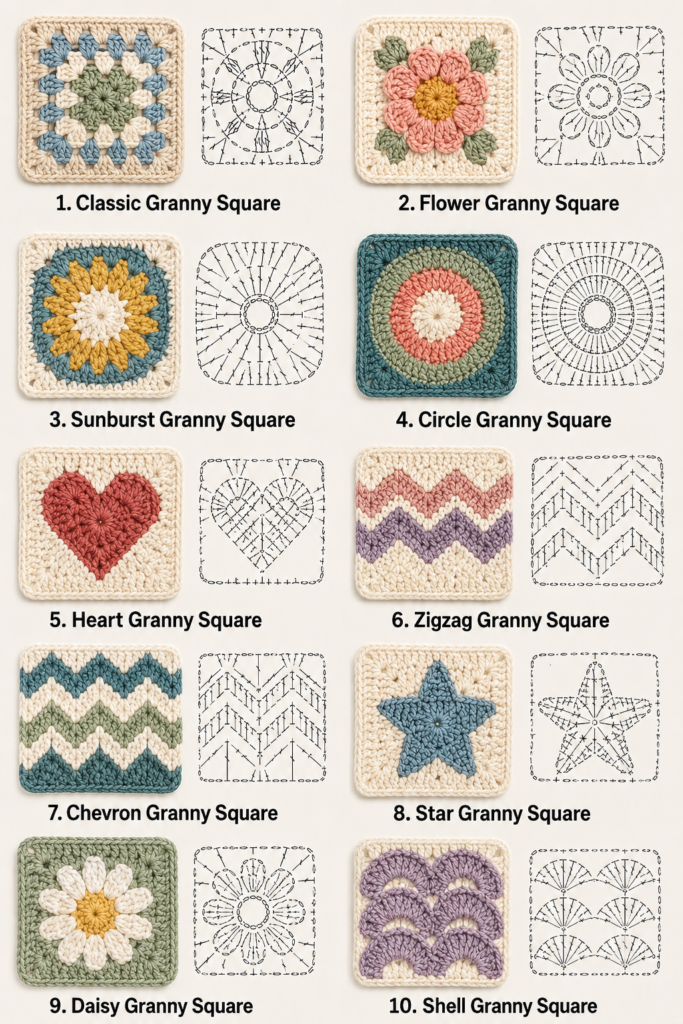
You will crochet a round circle motif that turns into a flat square, a classic granny variation that suits beginners who can chain and single crochet. Most crocheters finish one square in about 30 to 40 minutes, so a small blanket of 20 squares takes roughly 10 to 13 hours of crochet time.
Circle-in-a-Square Granny Square
Free crochet pattern · US terms
- Yarn
- 4 - Medium (worsted) — suggested
- Hook
- 5.0 mm (H-8) — verify with a swatch
- Gauge
- 14 dc x 7 rounds = 4 in (10 cm) in double crochet worked in joined rounds, unblocked (calculated, not measured)
- Size
- approx. about 6 x 6 in (15 x 15 cm) after light blocking
- Level
- Confident beginner
- Time
- about 35 min (estimate)
Written and count-checked on paper, not yet physically tested. Make the gauge swatch and the checkpoint below before you commit all your yarn.
This square starts as a small double crochet circle worked in joined rounds, then a square border of double crochet groups and chain corners turns it into a flat 6 in (15 cm) block. The circle stays centered because each corner round adds the same number of stitches on all four sides.
It suits confident beginners who have made a basic granny square and want a round-centered version. Squares join easily into blankets, cushion covers, and tote bags, and the border is simple enough to work while watching a show.
Before You Start
Materials
Suggested materials. Any yarn of the same weight works if you match the gauge.
1 skein worsted weight acrylic yarn, about 170 yd (155 m) per 100 g
Acrylic holds shape and washes well for blankets. Cotton worsted is a good substitute for bags and potholders because it is less stretchy.
5.0 mm (H-8) crochet hook
Matches worsted weight for a firm, even fabric. Go up to 5.5 mm (I-9) if your stitches are tight.
Tapestry needle
Needed for weaving in the two yarn tails. A blunt tip slides between stitches without splitting them.
Stitch marker
Useful for marking the first stitch of each round. A scrap of contrasting yarn works just as well.
Tape measure
For the gauge swatch and the round 4 checkpoint. Any flexible measure is fine.
Yarn needed (estimate): about 35 to 45 yd (32 to 41 m) per square, roughly 15 to 20 g
Gauge and Size
Gauge: 14 dc x 7 rounds = 4 in (10 cm) in double crochet worked in joined rounds, unblocked. This gauge is calculated from the yarn and hook above, not measured on a finished sample. Make a 4 in (10 cm) swatch first; change the hook size, not your tension, until it matches.
Finished size (approximate): about 6 x 6 in (15 x 15 cm) after light blocking. Your size depends on your gauge.
Abbreviations (US terms)
| Abbr. | Meaning |
|---|---|
| ch | chain |
| sl st | slip stitch |
| sc | single crochet |
| dc | double crochet |
| st | stitch |
| sts | stitches |
| sp | space |
| rep | repeat |
| FO | fasten off |
Special Stitches
Double crochet (dc)
Yarn over, insert hook into the stitch or chain space, yarn over and pull up a loop (3 loops on hook), yarn over and pull through 2 loops, yarn over and pull through the last 2 loops.
Chain space corner (ch-2 sp)
Two chains worked between two groups of double crochet. In the next round you work your stitches into the hole under those two chains, not into the chains themselves.
How This Pattern Is Written
- All rounds are worked in joined rounds: end each round with a slip stitch into the top of the first stitch of that round, then chain the stated number of chains to begin the next round.
- The starting chain of each round counts as one double crochet. The first double crochet of the round is worked into the next stitch or chain space, not into the base of the starting chain.
- Work with the right side facing you at all times. Do not turn between rounds.
- Each round begins with ch 3 unless the pattern says otherwise. That ch 3 stands in for the first dc of the round.
- The circle rounds use single crochet and double crochet increases. The square rounds use double crochet groups separated by chain spaces, which is what squares off the circle.
The Pattern
Circle Center
Square Border
Finishing and Assembly
Sizes and Variations
- Array
- Array
- Array
- Array
Troubleshooting
| What you see | Likely cause | Fix |
|---|---|---|
| The circle cups into a bowl shape | Too many increases in the circle rounds or a hook that is too small | Pull out the last round and work it with fewer increases, or switch to a hook one size larger. Blocking can also flatten a slight cup. |
| The square has wavy, ruffled edges | Too many stitches in the border rounds, often from working into the chain instead of the chain space | Check that each 3 dc group sits in a single stitch and each ch-2 space is skipped, not filled. Remove the last round and rework it. |
| The corners pull inward and the square looks rounded | Only one or two stitches worked into the corner chain space | Work 3 sc into each corner ch-2 space in Round 9. That extra stitch is what holds the corner at a right angle. |
| The square measures smaller than 6 in (15 cm) | Tighter tension than the gauge or a smaller hook | Measure one full square before starting a blanket. If it is small, go up one hook size and remeasure. |
| A hole appears at the center of the circle | The magic ring was not pulled tight enough | Pull the starting tail firmly before weaving it in. If the hole remains, thread the tail through the center stitches and pull again. |
Care
Machine wash in cool water on a gentle cycle and dry flat or tumble on low. Do not wring the square, because twisting pulls the circle out of shape. Block each square before joining for the straightest edges.
Questions Makers Ask
How many squares do I need for a blanket?
It depends on the blanket size. At about 6 in (15 cm) per square, a baby blanket needs roughly 20 to 24 squares and a throw needs about 48 to 60. Lay the squares out before joining so you can adjust the count.
Can I use a different yarn weight?
Yes. Use a hook one size smaller than the yarn label suggests so the fabric stays firm, and remeasure the square. The stitch counts stay the same, but the finished size will change.
Do I have to use a magic ring?
No. Chain 4 and join with a slip stitch to form a ring, then work Round 1 into that ring. The center may show a small hole, which you can close later with the tail.
Can I join squares as I go?
Yes. Work the final sc round and replace the corner chain on the joining edge with a slip stitch into the matching corner of the finished square. Beginners usually find it easier to make all squares first and join afterward.
Next: Try a flower-centered granny square next, which adds petal stitches inside the circle before you square it off.