WordPress Blog
Invisible Join Flower Coaster Crochet Pattern (Free)
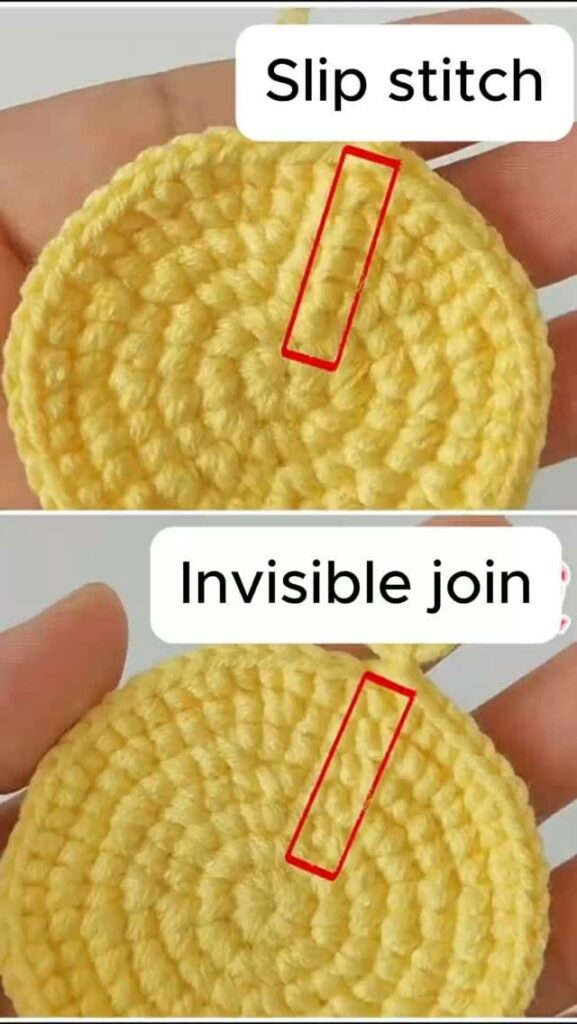
You will make a small flower-shaped coaster in joined rounds and finish each one with an invisible join, so the last stitch blends into the first. It uses beginner stitches only and each coaster takes roughly 30 to 40 minutes once you have practiced the join.
Invisible Join Flower Coaster Set
Free crochet pattern · US terms
- Yarn
- 4 - Medium (worsted) — suggested
- Hook
- 4.0 mm (G-6) — verify with a swatch
- Gauge
- 14 sc x 16 rounds = 4 in (10 cm) in single crochet, worked in joined rounds, unblocked (calculated, not measured)
- Size
- approx. About 4.5 in (11.5 cm) across from petal tip to petal tip, and about 0.2 in (5 mm) thick
- Level
- Beginner
- Time
- about 2 h 45 min (estimate)
Written and count-checked on paper, not yet physically tested. Make the gauge swatch and the checkpoint below before you commit all your yarn.
Each coaster is a flat flower worked from the center outward in joined rounds, then closed with an invisible join that replaces the usual slip stitch and chain. The petals are made by working taller stitches into chain spaces, so the shape stays flat without blocking.
The set suits a first or second project after you can make chain, single crochet and double crochet. Make one coaster to learn the join, then repeat the same rounds in different colors for a matching set of four to six.
Before You Start
Materials
Suggested materials. Any yarn of the same weight works if you match the gauge.
1 skein worsted weight cotton yarn, about 100 g (shown in one solid color; a second color optional for centers)
Cotton holds a flat shape and absorbs condensation better than acrylic. A smooth worsted acrylic works if you only want practice coasters.
4.0 mm (G-6) crochet hook
This hook gives a firm, flat fabric with worsted cotton. Go up to 4.5 mm (7) if your stitches are tight and the circle cups.
Stitch marker
Use it to mark the first stitch of each round so you can find the join point. A short scrap of contrasting yarn works too.
Tapestry needle
A blunt needle with an eye wide enough for worsted yarn is needed for the invisible join and for weaving ends. Any yarn needle you already own is fine.
Small sharp scissors
For trimming yarn tails close to the fabric. Any craft scissors will do.
Yarn needed (estimate): About 90 yd (82 m) total for five coasters, roughly one 100 g skein of worsted cotton
Gauge and Size
Gauge: 14 sc x 16 rounds = 4 in (10 cm) in single crochet, worked in joined rounds, unblocked. This gauge is calculated from the yarn and hook above, not measured on a finished sample. Make a 4 in (10 cm) swatch first; change the hook size, not your tension, until it matches.
Finished size (approximate): About 4.5 in (11.5 cm) across from petal tip to petal tip, and about 0.2 in (5 mm) thick. Your size depends on your gauge.
Abbreviations (US terms)
| Abbr. | Meaning |
|---|---|
| ch | chain |
| sl st | slip stitch |
| sc | single crochet |
| hdc | half double crochet |
| dc | double crochet |
| sp | space |
| st | stitch |
| sts | stitches |
| rep | repeat |
| FO | fasten off |
Special Stitches
Double crochet (dc)
Yarn over, insert hook in the stitch, yarn over and pull up a loop, yarn over and pull through two loops, yarn over and pull through the last two loops.
Invisible join (IJ)
Cut the yarn leaving a 4 in (10 cm) tail and pull it through the last loop on the hook. Thread the tail on a tapestry needle, skip the first stitch of the round, go under both loops of the second stitch from front to back, then back down through the center of the first stitch. Pull gently until the false stitch matches the height of the others.
How This Pattern Is Written
- All rounds are joined rounds: each round ends with a slip stitch into the first stitch, then a chain to begin the next round. The chain does not count as a stitch.
- The right side faces you at all times. Do not turn between rounds.
- The first stitch of each round is worked into the same stitch as the joining slip stitch, unless the round says otherwise.
- The invisible join is used only on the final round of each coaster, in place of the usual slip stitch and chain.
- Chain spaces count as spaces, not stitches. Stitch counts list stitches only.
- The center ring is a magic ring. If you prefer, chain 4 and join with a slip stitch to form a ring, then work Round 1 into the ring.
The Pattern
Flower Coaster (make 5)
Finishing and Assembly
Sizes and Variations
Coaster in two colors
work Rounds 1 to 7 in the center color, change to a second color before Round 8, and carry the first color up the back.
Larger trivet
work Rounds 1 to 9 with increases as written, then add Round 10 as 1 sc in each st around and Round 11 as Round 8, and finish with a petal round. Counts grow by 6 stitches per increase round.
Smaller mug mat
stop after Round 6 and work the petal round into every sixth stitch, giving 6 short petals.
Troubleshooting
| What you see | Likely cause | Fix |
|---|---|---|
| The circle ruffles at the edge after Round 5. | Too many increases for your stitch height, usually from loose tension or a hook that is too large. | Frog back one round and rework it with a smaller hook, or skip one increase in the round. Cotton relaxes after washing, so a slight wave is acceptable. |
| A small gap or bump shows where the round joins. | The slip stitch was worked into the chain instead of the first stitch, or the invisible join skipped the wrong stitch. | Undo the join. The slip stitch and the invisible join both go into the first stitch of the round, never into the beginning chain. |
| The petals lean to one side. | The petal stitches were worked into the skipped stitches instead of the chain space. | Check that the hook goes under the chain, not into the stitch tops. Rework the petal round. |
| The invisible join looks like a normal stitch with a visible bump. | The tail was pulled too tight or the needle passed through the wrong loops. | Pull the tail out and redo it, going under both loops of the second stitch and down through the center of the first stitch, then snug it only until it matches the neighbors. |
| The coaster curls up like a bowl. | Tension is too tight, so the outer rounds pull the center. | Go up one hook size or work the increase rounds more loosely, keeping the chain spaces open. |
Care
Machine wash cold on a gentle cycle and lay flat to dry. Cotton can be pressed with a warm iron on the wrong side, but do not stretch the petals.
Questions Makers Ask
What is an invisible join in crochet?
It is a way to finish the last round so the join looks like one more stitch instead of a slip stitch and chain. You cut the yarn, thread the tail through the last loop, then use a needle to mimic a stitch across the join.
Can I use acrylic yarn instead of cotton?
Yes, acrylic works and is cheaper for practice, but it does not absorb moisture as well and may melt if a hot mug is set on it. Cotton is the better choice for a coaster you will actually use.
How do I keep the flower flat?
Match the hook to your tension and keep the increase rounds even. Check after Round 3 that the circle is flat and about 2 in (5 cm) across; adjust the hook size before you go further.
How many coasters does one skein make?
A 100 g skein of worsted cotton is estimated to make five to six coasters at about 15 to 20 yd (14 to 18 m) each. Buy two skeins if you want a larger set in two colors.
Next: Try a matching flower potholder by working the same center in a thicker cotton and adding a hanging loop.