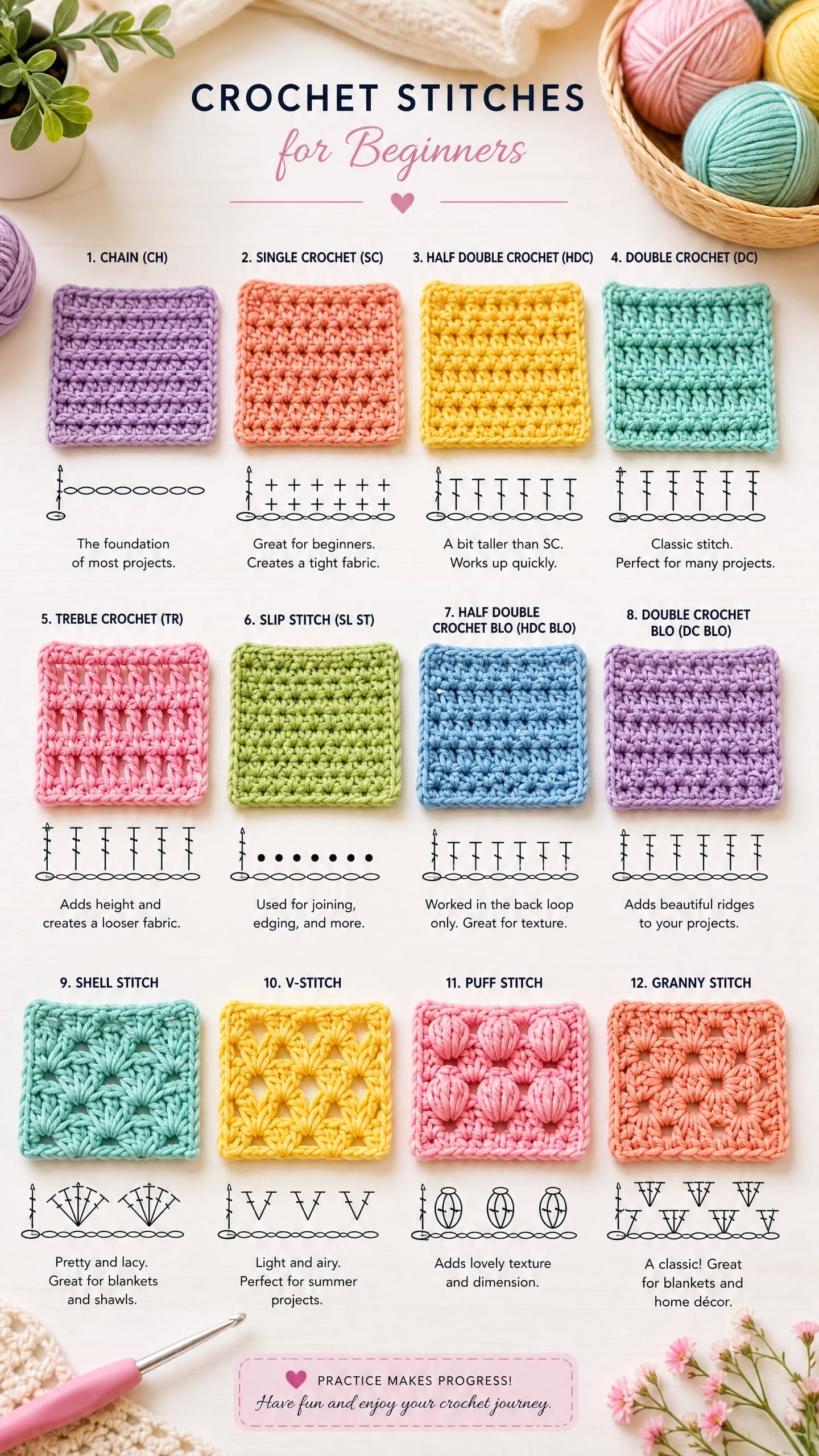
You will make a sampler blanket that teaches eight beginner crochet stitches in one piece, so you can practice each stitch before committing to a big project. It uses only chain, slip stitch, single crochet, half double crochet, double crochet, and a few simple combinations. Estimated time is about 6 to 9 hours for the practice-size throw; a full blanket takes longer.
Stitch Sampler Crochet Stitch Cheat Sheet Blanket
Free crochet pattern · US terms
- Yarn
- 4 – Medium (worsted) — suggested
- Hook
- 5.0 mm (H-8) — verify with a swatch
- Gauge
- 14 sts x 16 rows = 4 in (10 cm) in single crochet, unblocked (calculated, not measured)
- Size
- approx. about 34 in x 40 in (86 cm x 102 cm), calculated from the stated gauge and row counts
- Level
- Confident beginner
- Time
- about 7 h (estimate)
Written and count-checked on paper, not yet physically tested. Make the gauge swatch and the checkpoint below before you commit all your yarn.
This is a rectangular sampler throw worked in rows from the bottom up, with each band of rows showing a different stitch. The bands are separated by a simple single crochet border row, so the stitch changes are easy to see and easy to count.
It suits a confident beginner who can already make a chain and a single crochet. Every row is written with the stitch count at the end, so you can check your work as you go instead of waiting until the end.
Before You Start
Materials
Suggested materials. Any yarn of the same weight works if you match the gauge.
3 skeins worsted weight acrylic yarn, 100 g each (about 700 yd total)
Acrylic is easy to wash and holds stitch definition well for a sampler. A smooth cotton or cotton blend also works and shows texture more crisply.
5.0 mm (H-8) crochet hook
This hook matches worsted weight and gives a soft fabric that is not too stiff. If your stitches feel tight, go up to 5.5 mm (I-9).
Tapestry needle
Used to weave in the ends. A blunt tip slides between stitches without splitting the yarn.
Stitch markers (4 to 6)
Useful for marking the first and last stitch of each row so you do not lose count. A short piece of contrasting yarn works as a substitute.
Tape measure
Needed to check the gauge and the finished size. Any flexible measuring tape works.
Yarn needed (estimate): about 700 yd (640 m) / 3 skeins of 100 g
Gauge and Size
Gauge: 14 sts x 16 rows = 4 in (10 cm) in single crochet, unblocked. This gauge is calculated from the yarn and hook above, not measured on a finished sample. Make a 4 in (10 cm) swatch first; change the hook size, not your tension, until it matches.
Finished size (approximate): about 34 in x 40 in (86 cm x 102 cm), calculated from the stated gauge and row counts. Your size depends on your gauge.
Abbreviations (US terms)
| Abbr. | Meaning |
|---|---|
| ch | chain |
| sl st | slip stitch |
| sc | single crochet |
| hdc | half double crochet |
| dc | double crochet |
| st | stitch |
| sts | stitches |
| sp | space |
| rep | repeat |
| FO | fasten off |
Special Stitches
single crochet in back loop only (sc BLO)
Insert the hook under the back loop of the stitch only, not under both loops. Yarn over, pull up a loop, yarn over, pull through both loops. This leaves a visible ridge on the front of the fabric.
half double crochet (hdc)
Yarn over, insert the hook in the next stitch, yarn over, pull up a loop, yarn over, pull through all three loops on the hook.
double crochet (dc)
Yarn over, insert the hook in the next stitch, yarn over, pull up a loop, yarn over, pull through two loops, yarn over, pull through the last two loops.
How This Pattern Is Written
- Work in US terms. All rows are worked flat and turned at the end of each row unless the row says otherwise.
- The turning chain at the start of a row does not count as a stitch in the single crochet rows. In hdc and dc rows the turning chain counts as the first stitch, as stated in that row.
- The right side is the side facing you when you finish an odd-numbered row. Keep the same side facing out when you join the border.
- Each band of stitches is separated by one row of single crochet. This makes the stitch change clear and keeps the row counts easy to follow.
- The stitch count stays the same in every row of the main body. If your count changes, you have added or dropped a stitch.
- The border is worked in rounds around the whole blanket after the body is finished.
- Border counts given are the flat counts for this size; if you change the body size, recount the border before working Round 2.
The Pattern
Body
Border
Finishing and Assembly
Sizes and Variations
Practice swatch
Ch 19 and work Rows 1-21 once. This makes a small sampler about 5 in (13 cm) wide that you can keep as a reference card.
Baby blanket
Use 3 skeins of worsted yarn and work 60 sts across instead of 18. The stitch bands stay the same, but each band needs more rows to keep the same proportions.
Scrap blanket
Work each stitch band in a different color. Change color on the single crochet separator row so the ends hide inside the border.
Washcloth
Use cotton yarn and 30 sts across. Work only the sc, hdc, and dc bands, then add one round of border.
Troubleshooting
| What you see | Likely cause | Fix |
|---|---|---|
| The blanket gets wider or narrower as you go | You are adding or dropping a stitch at the start or end of a row | Count the stitches at the end of every row. Place a stitch marker in the first and last stitch of the row so you can find them easily. |
| The edges look uneven and wavy | The turning chain is being counted as a stitch in the single crochet rows | In sc rows the ch-1 is just a turning chain. Skip it and work the first sc into the first real stitch of the row. |
| The dc band has gaps between stitches | The first dc is worked into the turning chain instead of the next stitch, or the tension is loose | Work the first dc into the second stitch of the row. Keep the yarn slightly snug and check your gauge again. |
| The border ruffles instead of lying flat | Too many stitches were worked along the side edges | Undo the border and work fewer stitches along the sides. Aim for about 2 sc in every 3 row ends along each side. |
| The BLO band does not show a ridge | The hook went under both loops instead of the back loop only | Look at the top of the stitch. You will see two loops. Insert the hook under the loop farthest from you and leave the front loop free. |
Care
Machine wash cold on a gentle cycle and tumble dry low, or lay flat to dry. Acrylic can be pressed lightly with a warm iron over a cloth, but never touch the iron directly to the yarn.
Questions Makers Ask
How many stitches does this blanket use?
It samples eight beginner stitches and combinations across the body, including single crochet, half double crochet, double crochet, and single crochet in the back loop only. The border adds two more rounds of single crochet.
Can I make this blanket bigger?
Yes. Chain any odd number of stitches for the width you want, then keep the same row counts for each stitch band. The border stitch count will change, so work it evenly around your new size.
Do I need to block the blanket?
Blocking is optional for acrylic, but a light mist and flat dry helps the edges lie straight. Natural fibers like cotton and wool benefit more from blocking.
What if my gauge is different from the pattern?
Change your hook size until your swatch matches 14 stitches and 16 rows in 4 in (10 cm). A larger hook makes the blanket bigger, and a smaller hook makes it smaller.
Next: Try a granny square blanket next to practice working in rounds and joining motifs.