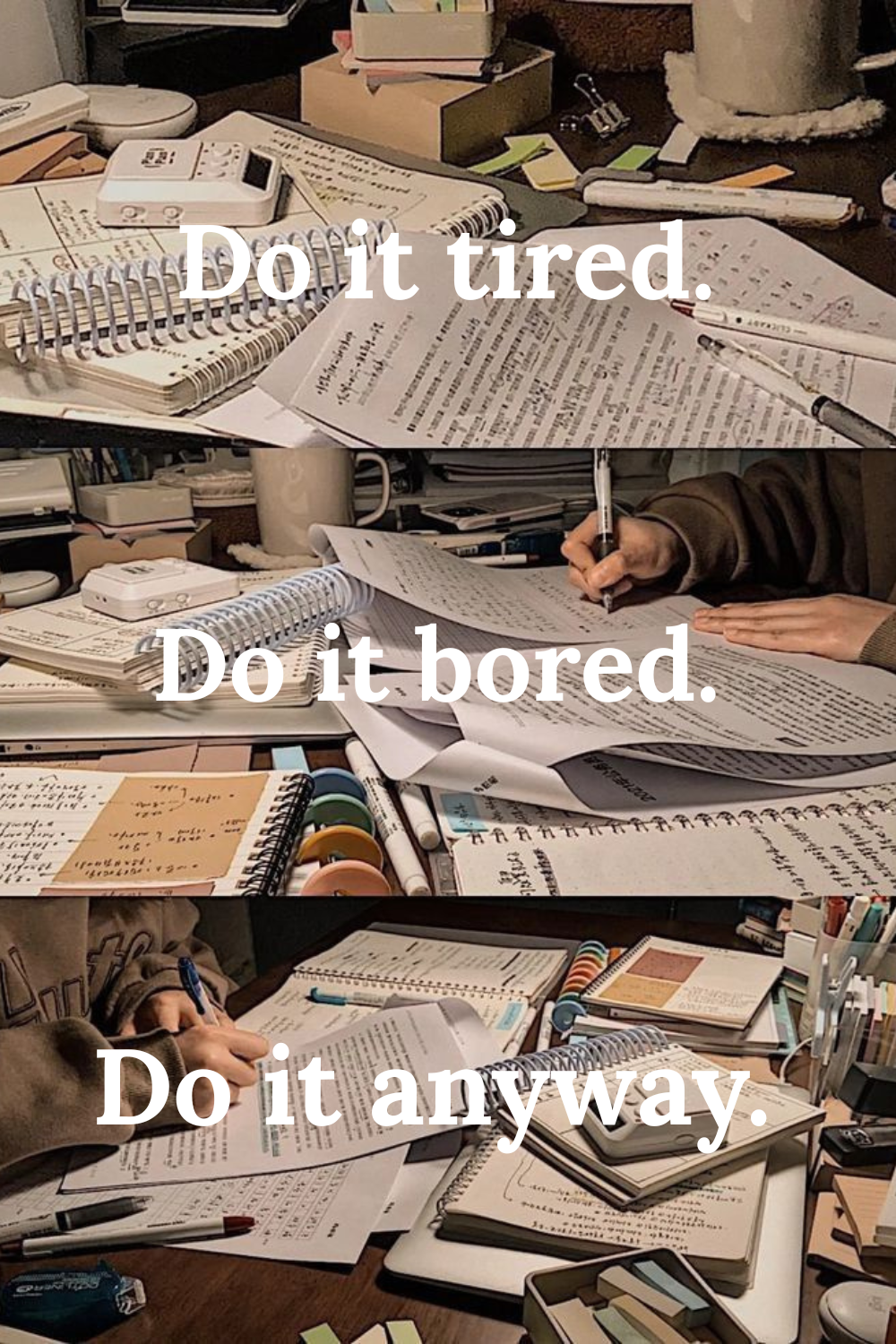
You have felt it: the desk lamp is on, the notes are open, and your brain is already negotiating an exit. That is exactly the moment the pin on your screen was written for. “Tired isn’t a reason. Bored isn’t a reason. Unmotivated isn’t a reason.” The line behind it — do it anyway — is not a slogan. It is a decision rule. The curated stops below are the places where that rule lives: quote archives, discipline frameworks, focus tools, and quiet corners of the internet full of people who kept going when inspiration did not show up. Save the ones that land. Come back on the nights you need them.
Table of Contents(Click to Toggle)
- Why “Do It Anyway” Beats Waiting for Motivation
- 17 Places That Keep You Consistent
- 1. Do It Anyway (Kent M. Keith)
- 2. The Paradox of Success
- 3. Quotes to Live By
- 4. Tiny Buddha
- 5. Zen Habits
- 6. James Clear
- 7. The Marginalian
- 8. BrainyQuote
- 9. Goodreads Quotes
- 10. The School of Life
- 11. Focusmate
- 12. Forest
- 13. Cold Turkey Blocker
- 14. StudyStream
- 15. Anki
- 16. Flow Club
- 17. 750 Words
- Bonus Mentions
- The Quiet Power of Showing Up Anyway
Why “Do It Anyway” Beats Waiting for Motivation
Motivation is a mood. Discipline is a system. The students who finish the thesis, pass the exam, or ship the project are rarely the ones who felt inspired every single night — they are the ones who built a default answer for the nights they did not. “Do it anyway” works because it removes the debate. You stop asking whether you feel like it and start asking what the next small action is.
The internet is full of places that quietly support that shift: quote collections that reframe a bad evening, habit frameworks that shrink the task until it is startable, and focus tools that make distraction slightly harder than studying. None of them are magic. All of them are useful when your willpower is running low. The seventeen stops below are ordered from mindset to mechanics — start with the words, then borrow the systems.
17 Places That Keep You Consistent
1. Do It Anyway (Kent M. Keith) : The original source of the philosophy behind the pin
What it is: The home of the Paradoxical Commandments, the ten statements written by Kent M. Keith in 1968 that begin with lines like “People are illogical, unreasonable, and self-centered. Love them anyway.”
Category: Philosophy and mindset
Why it stands out: The tenth commandment is the one that maps onto study discipline: “Give the world the best you have and you’ll get kicked in the teeth. Give the world the best you have anyway.” The site also tells the surprising story of how the text traveled from a student pamphlet to Mother Teresa’s wall, which makes the words feel less like a poster and more like a relay.
Best for: Readers who want the real origin of the “do it anyway” idea before they borrow it for a caption.
2. The Paradox of Success : Keith’s own explanation of why the commandments still work
What it is: Kent M. Keith’s companion resource explaining the thinking behind the Paradoxical Commandments and how meaning survives when reward does not.
Category: Mindset essays
Why it stands out: It gives you language for the exact feeling that kills study sessions — doing good work that nobody claps for. The essays argue that meaning is the return, not applause, which is a genuinely useful reframe at 11 p.m. with three chapters left.
Best for: Students who need a reason to keep going that does not depend on grades or praise.
3. Quotes to Live By : A calm, ad-light quote archive you can actually read
What it is: A long-running quote collection organized by theme, author, and life situation, with short reflections rather than endless pop-ups.
Category: Quote archive
Why it stands out: The discipline and perseverance categories are deep, and the site keeps pages readable instead of burying quotes under autoplay video. It is the kind of place you can open for one line and leave with three.
Best for: Building a small personal rotation of lines you return to on low-energy nights.
4. Tiny Buddha : Short, honest essays about doing hard things while tired
What it is: A community-driven blog of short personal essays on habits, anxiety, perfectionism, and persistence.
Category: Personal growth writing
Why it stands out: Posts are typically 600-900 words, written in first person, and focused on one concrete change. The comments are moderated and unusually kind, which matters when you are already feeling behind.
Best for: A five-minute read during a study break that resets your tone without eating an hour.
5. Zen Habits : The minimalist approach to starting when you don’t want to
What it is: Leo Babauta’s long-running blog on simplicity, habits, and doing one thing at a time.
Category: Habit philosophy
Why it stands out: The archive is plain-text, low-distraction, and free of growth-hack noise. Pieces like “The Only Thing You Need to Do” reduce a mountain of work to a single next action, which is precisely the move that breaks a procrastination spiral.
Best for: Overwhelmed students who need permission to shrink the task instead of forcing willpower.
6. James Clear : The clearest free writing on consistency over intensity
What it is: The article archive behind Atomic Habits, covering habit formation, environment design, and identity-based change.
Category: Habit systems
Why it stands out: The free articles are as useful as most paid courses. “How to Build a New Habit” and the habit-tracker guide give you specific mechanics — two-minute rule, habit stacking, environment cues — rather than vague encouragement.
Best for: Turning “study every day” from a wish into a repeatable routine with a trigger.
7. The Marginalian : Deep essays on perseverance from writers who kept going
What it is: Maria Popova’s long-form archive of essays on books, art, science, and the inner life.
Category: Literary essays
Why it stands out: Where most quote sites repeat the same twenty lines, The Marginalian digs into primary sources — letters, diaries, drafts — and shows how real people worked through doubt. The piece on Ursula K. Le Guin’s discipline and the one on Beethoven’s creative endurance are standout examples.
Best for: Long study breaks when you want something substantial instead of a scroll.
8. BrainyQuote : Fast lookup when you need one line right now
What it is: One of the largest searchable quotation databases, organized by author, topic, and keyword.
Category: Quote search
Why it stands out: Search is instant and the topic pages for “perseverance,” “discipline,” and “hard work” are broad enough to surface less obvious voices. It is not curated for depth, but it is unbeatable for speed when you want a line for a whiteboard or a caption.
Best for: Quick retrieval, not deep reading — treat it as a dictionary, not a library.
9. Goodreads Quotes : See which lines real readers actually highlighted
What it is: A massive community-sourced quote database where readers attach lines to specific books and editions.
Category: Community quotes
Why it stands out: Because quotes are linked to books and tagged by readers, you can trace a line back to its context instead of trusting a cropped image. Popular highlights show which passages thousands of people found worth marking, which is a useful filter.
Best for: Finding a quote and its source book in the same visit.
10. The School of Life : Philosophical comfort for the nights you feel behind
What it is: A London-based organization publishing essays, videos, and tools on emotional and philosophical life.
Category: Applied philosophy
Why it stands out: Their writing on failure, perfectionism, and self-compassion is unusually practical. The essay on why we procrastinate frames it as an emotional problem rather than a character flaw, which is a more useful diagnosis than another productivity hack.
Best for: Reframing guilt so it stops draining the energy you need for the actual work.
11. Focusmate : A stranger on video keeps you accountable for 50 minutes
What it is: A virtual co-working platform that pairs you with another person for a scheduled silent work session over video.
Category: Accountability tool
Why it stands out: You state your goal at the start and report on it at the end, which turns an abstract intention into a small social commitment. The free tier allows several sessions per week, and the ritual of showing up for another person is often stronger than any app timer.
Best for: People who can study for others but not for themselves.
12. Forest : Grow a tree by leaving your phone alone
What it is: A focus app that plants a virtual tree when you start a timer and lets it wither if you leave the app.
Category: Focus app
Why it stands out: The visual stake is the trick — losing a tree you watched grow is oddly painful. Coins earned from completed sessions can fund real tree planting through the developer’s partner organization, so the streak has an offline result.
Best for: Phone-in-hand studiers who need a gentle, gamified barrier.
13. Cold Turkey Blocker : Make distraction genuinely difficult, not just discouraged
What it is: A desktop blocker for Windows and macOS that can block sites and applications on a schedule or on demand.
Category: Distraction blocker
Why it stands out: The free version is capable, and the paid version adds locked modes that are hard to undo mid-session — which is the whole point. You set the rules once, when you are rational, and they hold when you are not.
Best for: Students whose discipline collapses the moment a browser tab opens.
14. StudyStream : Always-on study rooms full of people doing the same thing
What it is: A platform hosting 24/7 video study rooms where participants work silently on camera.
Category: Virtual study space
Why it stands out: Unlike scheduled co-working, you can drop in at 3 a.m. and find a room with dozens of people typing. Seeing other people grind quietly is a surprisingly strong antidote to the feeling that you are the only one still working.
Best for: Late-night studiers who want company without conversation.
15. Anki : Spaced repetition that rewards consistency over cramming
What it is: A free, open-source flashcard program that schedules reviews based on how well you remember each card.
Category: Learning tool
Why it stands out: Anki is the clearest proof of the “do it anyway” principle: twenty minutes daily beats six hours the night before, and the algorithm shows you why. It is free on desktop and Android, with a paid iOS app that funds development.
Best for: Anyone memorizing vocabulary, anatomy, or formulas over months rather than days.
16. Flow Club : Scheduled focus sessions with a human host
What it is: A paid co-working service offering hosted video sessions with structured starts, breaks, and check-ins.
Category: Guided accountability
Why it stands out: The host runs the session, so you do not have to design your own structure — you just show up and follow. Sessions are scheduled across time zones, and the format suits people who need external pacing more than they need another timer.
Best for: Those who struggle to start without someone else setting the rhythm.
17. 750 Words : A private daily writing habit that clears mental clutter
What it is: A minimalist site built around writing 750 words privately each day, inspired by morning pages.
Category: Daily practice
Why it stands out: It gamifies consistency with streaks and simple stats rather than public sharing. Ten minutes of unfiltered writing before a study session often surfaces the real reason you are avoiding the work — which is more useful than another motivational quote.
Best for: Students who need to empty their head before they can fill it with course material.
Bonus Mentions
Habitica : Turn your study habits into a retro role-playing game
What it is: A free habit tracker styled as an RPG where tasks earn experience and gold.
Why it stands out: Party features let friends see your progress, adding light social accountability without a video call.
Calm : A short wind-down before a late study block
What it is: A meditation and sleep app with a free tier of guided sessions.
Why it stands out: Five minutes of breathing before you start can lower the resistance that makes beginning feel impossible.
Rainy Mood : Free ambient rain for instant study atmosphere
What it is: A single-page site that plays looping rain sounds in the browser.
Why it stands out: No account, no ads mid-loop, and it works on any device — the simplest possible environment cue.
Hemingway Editor : Clean up essays when your brain is too tired to edit
What it is: A free browser-based editor that flags long sentences and passive voice.
Why it stands out: It gives you concrete revisions to make, so editing becomes mechanical instead of creative.
The Quiet Power of Showing Up Anyway
None of the seventeen stops above will make you want to study. That is not their job. Their job is to make the next small action easier to take on a night when desire is missing — a line that reframes the mood, a habit rule that shrinks the task, a stranger on video who expects you at eight o’clock. That is what consistency actually looks like from the inside: not a heroic streak, just a series of unremarkable decisions to begin anyway.
Bookmark two or three of these. Use them on the boring nights, not the inspired ones, because the inspired nights take care of themselves. And remember the line that started all of this: tired, bored, and unmotivated are descriptions of how you feel, not instructions about what you do next.
Which of these do you already use, and what is the one quote or tool you return to when you least feel like starting? Share it in the comments — someone else reading this tonight probably needs exactly that.