
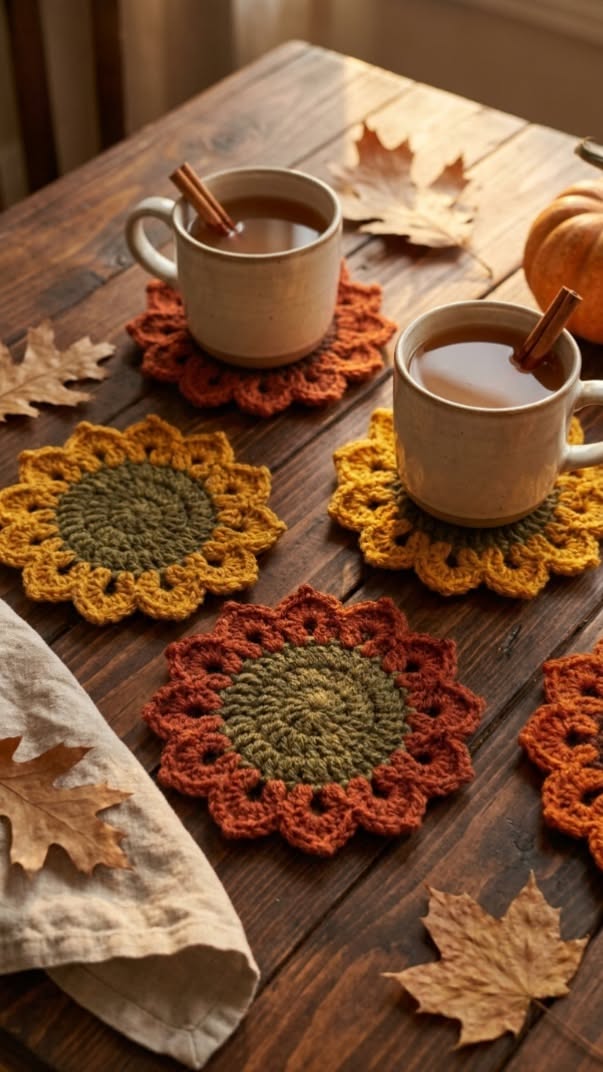
You will make one sunflower coaster in joined rounds, then repeat it for a set. The skills are simple: single crochet, double crochet, chain, and slip stitch. Plan on about 45 minutes per coaster, so a set of four takes roughly 3 hours.
Sunflower Coaster Set
Free crochet pattern · US terms
- Yarn
- 2 – Fine (sport weight cotton) — suggested
- Hook
- 3.5 mm (E-4) — verify with a swatch
- Gauge
- 16 sc x 18 rounds = 4 in (10 cm) in single crochet worked in joined rounds, unblocked (calculated, not measured)
- Size
- approx. About 4.5 in (11.5 cm) across including petals
- Level
- Beginner
- Time
- about 3 h (estimate)
Written and count-checked on paper, not yet physically tested. Make the gauge swatch and the checkpoint below before you commit all your yarn.
Each coaster is a flat cotton circle with a raised center and a ring of pointed petals around the edge. The center is worked first in joined rounds, then the petals are worked directly into the last round of the center so there is no sewing of petals.
The set suits beginners who can already hold tension in single crochet and want practice with double crochet and picot-style points. Cotton keeps the coaster flat and absorbs condensation better than acrylic.
Before You Start
Materials
Suggested materials. Any yarn of the same weight works if you match the gauge.
2 balls of 50 g sport weight cotton, about 130 yd (120 m) total, in autumn gold
Cotton holds its shape and lies flat for coasters. A smooth cotton shows the petal points clearly; a soft acrylic substitute works but may curl at the edges.
Small amount of sport weight cotton in dark brown, about 10 yd (9 m)
Used for the center circle so the flower reads as a sunflower. Any medium brown cotton is fine; you can also use the gold throughout for a single-color coaster.
3.5 mm (E-4) crochet hook
Matches the sport weight cotton at a firm coaster tension. If your circle ruffles, go down one hook size rather than changing the pattern.
Tapestry needle
For weaving in ends and for the small center stitches. A blunt tip will not split the cotton plies.
Stitch marker
Marks the first stitch of each round so the joined rounds stay aligned. A scrap of contrasting yarn works too.
Yarn needed (estimate): About 130 yd (120 m) total for a set of four, roughly 2 balls of 50 g
Gauge and Size
Gauge: 16 sc x 18 rounds = 4 in (10 cm) in single crochet worked in joined rounds, unblocked. This gauge is calculated from the yarn and hook above, not measured on a finished sample. Make a 4 in (10 cm) swatch first; change the hook size, not your tension, until it matches.
Finished size (approximate): About 4.5 in (11.5 cm) across including petals. Your size depends on your gauge.
Abbreviations (US terms)
| Abbr. | Meaning |
|---|---|
| ch | chain |
| sl st | slip stitch |
| sc | single crochet |
| dc | double crochet |
| st | stitch |
| sts | stitches |
| sp | space |
| inc | increase (2 sc in the same stitch) |
| rep | repeat |
| FO | fasten off |
| MR | magic ring |
Special Stitches
Picot point (pc)
Chain 2, then slip stitch into the second chain from the hook. This makes a small bump at the tip of a petal. It is worked at the end of each petal before you return down the side.
Petal (pet)
Worked into one stitch of the center's last round: slip stitch in the stitch, chain 3, 2 double crochet in the same stitch, chain 2, slip stitch into the second chain from the hook, then 2 double crochet in the same stitch again, chain 3, slip stitch in the same stitch. This makes one pointed petal.
How This Pattern Is Written
- All instructions use US crochet terms.
- The center is worked in joined rounds. Each round begins with a chain that does not count as a stitch, and you join with a slip stitch to the first stitch of the round.
- The right side of the coaster faces you at all times; do not turn between rounds.
- Petals are worked into the front loops only of the final center round (Round 5), so the back of the coaster stays flat on the table.
- Each petal uses one front loop of Round 5 and is separated by one skipped front loop, so the petal count is half the stitch count of Round 5 (30 front loops = 15 petals + 15 skipped loops).
- In Round 6 the opening chain-1 and slip stitch are the join point and are not counted as a petal or a stitch.
- Gauge and finished size are calculated from the stated gauge and are approximate. Yardage is an estimate.
The Pattern
Center
Petals
Finishing and Assembly
Sizes and Variations
Larger trivet
Work Rounds 1-5 once more with an extra increase round (36 sc) before the petals, and use a 4.0 mm (G-6) hook; you get a wider mat with 18 petals.
Two-color petals
Change to a second autumn color after Round 5 and work Round 6 in the new color; counts stay the same.
Square coaster
Work Rounds 1-4, then work four corner rounds with 2 sc in each corner stitch to square the shape before adding petals to the last round.
Troubleshooting
| What you see | Likely cause | Fix |
|---|---|---|
| The center ruffles and will not lie flat | Too many stitches for the hook size, usually from loose tension or an extra increase | Frog back to the checkpoint and rework Round 4 with a smaller hook, or skip the increase in Round 5 and work 30 sc evenly instead. |
| The coaster cups into a bowl shape | Tension is too tight or the yarn is thinner than the suggested sport weight | Go up one hook size and rework the center; a coaster should sit flat on the table with no weight on it. |
| Petals look crowded or overlap | Petals were worked into every front loop instead of every other loop | Undo Round 6 and check that you skip one front loop between petals; each petal should have a small gap on each side. |
| The petal tips curl forward | The picot chain was pulled too tight | Make the chain 2 of the picot slightly loose, and block the coaster flat while damp so the points dry open. |
| The back of the coaster is lumpy | Ends were woven through the petal bases or the optional Round 7 was worked too tightly | Weave ends under the center only, and work Round 7 in the back loops with the same tension as the center. |
Care
Hand wash in cool water with a little mild soap, squeeze gently without wringing, and lay flat to dry away from direct heat. Do not tumble dry; cotton coasters can shrink and lose their flat shape.
Questions Makers Ask
How much yarn does one sunflower coaster use?
About 30 to 35 yd (27 to 32 m) of sport weight cotton per coaster, so a 50 g ball usually makes two to three. A set of four needs roughly two balls total, split between the gold and brown.
Can I use worsted weight cotton instead?
Yes, but change the hook to 4.5 mm (7) and expect a coaster about 5.5 in (14 cm) across. Work Rounds 1-4 only to the checkpoint, since worsted cotton fills the circle faster.
Do I have to use a magic ring?
No. Chain 3 and join with a slip stitch to form a ring, then work Round 1 into the ring. The magic ring just closes the center hole more neatly.
Are these coasters washable?
Yes, hand washing is safest for cotton coasters. Machine washing can work on a gentle cycle in a mesh bag, but the petals may need reshaping while damp.
Next: Try a matching sunflower potholder worked in the same joined-round method with a thicker cotton and a double-thick back.